Concrete cladding for wood burning ovens
Concrete cladding application for wood fired brick oven dome. With its heat absorbing mass, and the heat retention of cladding, the oven becomes extra efficient.
Same as with wood fired ovens without the cladding, ovens with the cladding layer included will reach the pizza making temperature in 1-1/2 hour. The state also called as carbon burn off. To add cladding is very important in several aspects, it will not effect heating time of the oven to reach the pizza making temperature in the dome unless you were mad about a 10 minutes difference.
Having cladding has many advantages one notices clearly after the two oven types are compared. To apply an ordinary concrete cladding layer is very simple. This page focuses more on oven cladding properties, but for more on efficiency and using ovens from practical points of view read the "Which dome is better" page - link is at the bottom, if you haven't read it already.
Oven cladding basics
In oven with cladding, same as with thin shell wood fired ovens, the hot face of the dome walls inside turns white in under 1 hour, the floor is ready shortly after. Spread your red-hot embers to 1 or 2 sides, one side is just perfect too to create a place for pizza and start making it (you may have to give it about 10 minutes for the floor to cool down slightly.)
If you plan to make pizza for a longer time, maintain continuous gentle fire going on somewhere at the back.
What happens next?
Here is the time where the main breaking point in having cladding or not having cladding differences show up. Oven with cladding has better/bigger volume in heat absorbing mass because as well as firebricks the additional concrete cladding layer is also dense therefore it has a great thermal conductivity with heat retention too. Firebricks with cladding create thicker chamber walls and so the bigger mass absorbs and stores more needed heat for much longer and efficient cooking. In case you maintained that continuous fire while making pizzas at start and now you want to cook or bake, that's good as well because while continuous fore was on firebricks with cladding absorbed even more heat. This is very important!
Why oven cladding?
Cladding as an additional heat absorbing heavy-mass layer is a very beneficial thing to have. For a few fundamental reasons.
When you make pizzas the immediate heat from fire or still glowing cinder is assisting you to make fabulous pizzas. Don't forget that continuous small fire is again extra energy to be stored in bigger mass again. But when you stop fire or making pizzas, and want to cook meals in less hot environment for long time cooking in 205°C - 400°F atmosphere, or roasting a few big pieces at once and long baking in 190.5°C - 375°F (reloading batches of bread after a single heat up), and after to dry fruits or halved tomatoes (all these in heat stored in from previous single fire), temperature starts to drop and right here the cladding is useful.
That is only a bit of concrete but vital for other things than pizzas. Go to butcher and ask what are the requirements to roast 11 lb. - 5 Kg big turkeys and other such roasts (and even larger roasts, and big pots!), I documented making few. Or for baking, oven cladding layer is essential. Oven that doesn't hold temperature right will not be able to do these many things.
What else is interesting about oven cladding?
Nothing, it's only a bloody concrete ... joking laterrrrrrrrr. Or did you mean these?
Larger oven should have 10cm - 4" and thicker concrete cladding applied. I like old or now-days built ovens that have instead of concrete another/secondary brick layer instead of concrete cladding added on top to firebricks (domes of 230cm - 9" firebrick dome plus 230cm - 9" cheaper building solid clay bricks, usually seconds).
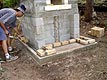
After concrete cladding was poured
E.g. in custom built 6ft - 1.8m and larger restaurant ovens or wood fired bakeries. It's all about physical laws, using energies efficiently to feel good, and to save (time, money, planet because you fire ones and do heaps of things with one firing and having fun.)
Before applying the concrete cladding layer
Wise is to heat up the firebrick oven part from the inside a little, with an electric spiral heater or a gas burner, to gently/gradually soak a bit of the low heat through the firebricks (this will slightly expand them.) Then pour the concrete cladding on top. This achieves having lesser pressure within the firebricks work once heated for cooking.
Concrete cladding recipe.
Mix dry ingredients then add water. The oven cladding can be mixed by hand using shovel and wheelbarrow. Parts by volume:
4:1:1 - Concrete blend : Portland cement : Lime
Regarding the "concrete blend", it's the simple mix of stones with sand, in which a bonding agent goes as to make a concrete type;
You can buy concrete blend or mix your own at home with 4 parts stones (10-20mm or 1/2-3/4 inch size) and 2 parts sand. I like to use blend that comes from river it's strong and needs less water, it has round stones and when mixing by hand you spend less energy. Crushed rock is fine too.
Aluminum foil between firebricks and the cladding layer.
Placing the thin alumina foil onto the firebricks, without a helper, can be a bit difficult in a windy day. Wind blows it around very easily. But that's the only issue there is about it so to speak. Nothing is impossible.
This is an ordinary aluminum foil from a supermarket, sold in 2 or 3 widths and thickness. Buy the stronger one while considering the price as well. This foil has one main role to play. It is not there to reflect heat back; there is no light, why would you want to reflect heat away from cladding? We need heat in the cladding. Any way, the foil prevents concrete bonding with firebricks, which is the main reason.
More about that aluminium foil
Other than that, this foil also stops firebricks to absorb water from the soft concrete when it is being applied and before it properly and fully cures. Instead of an aluminum foil a baking paper can be used. Also a candle wax or a plastic wrap could be used, but it would burn and be felt in the air for the 2 first firings at least.
Cladding makes brick ovens extra efficient. It makes cooking and baking a lot better in several performance and pleasing aspects.
I hope you find the concrete cladding information useful.
 by Rado Hand
Related: learn more about:
- Which dome is better - a round igloo shape or a rectangle?
- Refractory mortar - kinds and mixing formula's for making your own
- Dome cladding layer - for efficiency plus durability. Cladding making directions.
- Thermal insulation - types and mixing formula's